Final Expense Direct Mail: How to Build a Predictable Lead System
Final Expense is, before anything else, a numbers business. Leads become appointments, appointments become presentations, presentations become applications, applications become issued business, and issued business becomes renewals. Break any link in that chain and the income stops.
Direct mail has stayed at the center of Final Expense prospecting for one reason: the consumer takes a physical action to request information. Somebody read a piece of mail, filled out a card, and put it back in the mailbox.
Stop thinking only about what one lead costs. Start understanding what it costs to generate an entire batch of opportunities.
Contracts. Leads. Training. Technology. Agent First.
On this page
- What Is a Direct Mail Lead?
- Anatomy of a Mailer
- Per Lead vs. Per 1,000
- Cost-Per-Lead Calculator
- The Economics of One Sale
- Why Consistency Matters
- Building a Lead Budget
- The Direct Mail Flywheel
- What Determines Results
- Your Contract Level
- Why Agent First Built a Mail Program
- More Than Leads
- FAQ
- Sources & Methodology
The basics
What Is a Final Expense Direct Mail Lead?
A mailed solicitation goes into a targeted territory. A household that wants information responds. That response — the card, the call, the scan — is the lead.
Targeted Households
Mail Piece
Consumer Responds
Lead Returned
Agent Contacts Lead
Appointment
Sale
How the targeting works
Final Expense direct mail generally targets households that fit selected demographic and geographic criteria — an age band that matches the product, income and homeownership selects, and a defined ZIP, city or county footprint. The list decides who ever gets the chance to respond.
Common response mechanisms
- Business reply card
- Postage-paid response card
- Phone response to a printed number
- QR or digital response where appropriate
A returned card is not a sale. It is an opportunity to have a conversation.
That distinction matters, because the prospect took an affirmative action instead of simply becoming a name purchased from a database. It is a warmer starting point — and still only a starting point.
Mail design
What a Final Expense Mailer Actually Looks Like
Formats vary — postcards, letter-and-reply-card packages, folded self-mailers — but the working parts are consistent.
There are many different versions of these leads in the market. Agent First has its own lead created specifically to put agents in the best possible position to succeed.
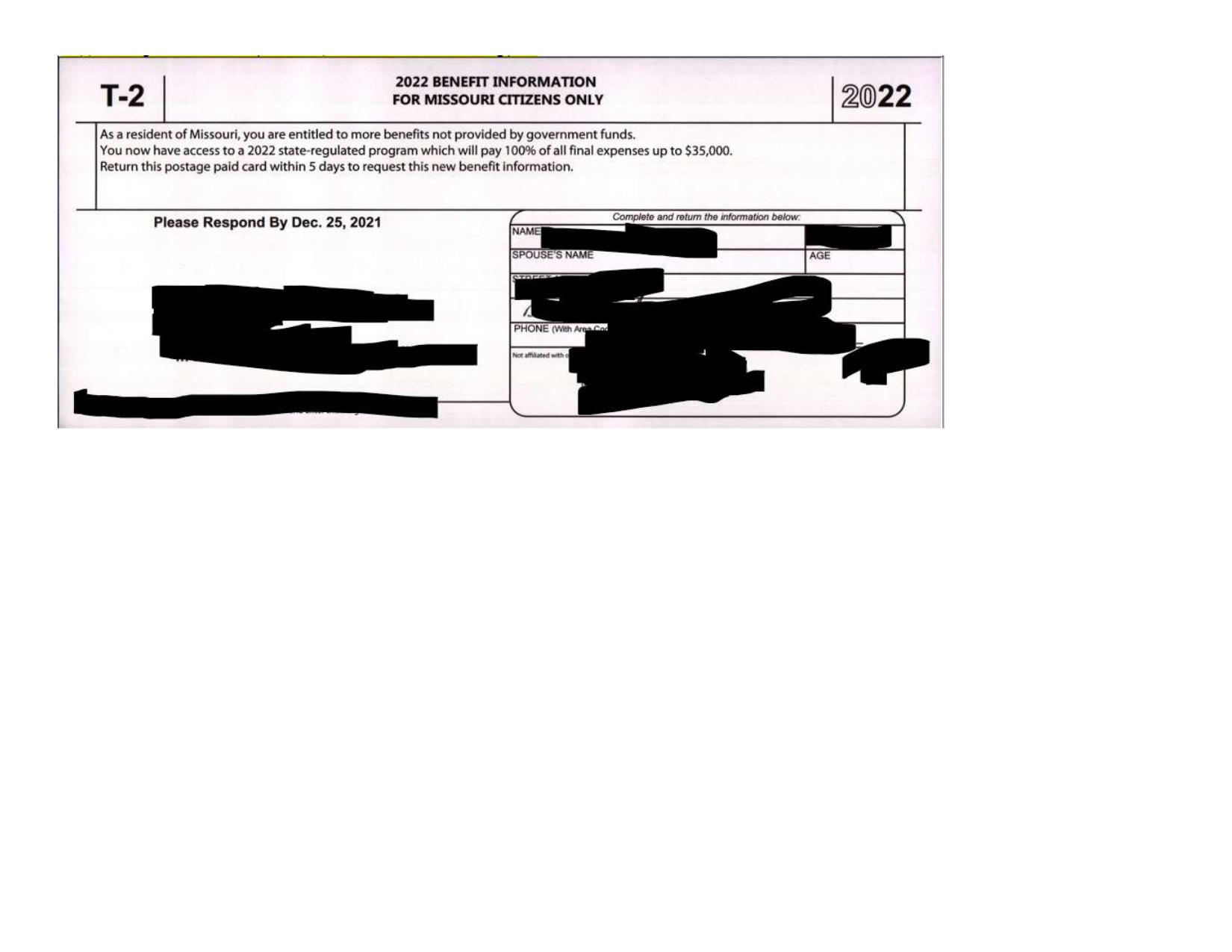

Examples shown for educational illustration. Personal details have been redacted.
Clarity and compliant wording matter
A mail piece should make clear that it is an insurance solicitation. Mail designed to deliberately impersonate government correspondence, benefit notices or official award letters is not something we recommend, and it draws regulatory and carrier attention. Pieces that are honest about what they are also produce prospects who are not angry when you knock on the door.
Acquisition models
Buying Leads vs. Owning the Mailing
These are two genuinely different business decisions, and most agents never have the difference explained to them.
Pay Per Lead
You pay a predetermined amount for each lead delivered to you.
Advantages
- Predictable cost per lead
- Lower upfront commitment
- Easier entry point for some new agents
Potential disadvantages
- Someone else controls the economics
- You may not receive every response the mailing generated
- Pricing includes the vendor's risk and margin
- Exclusivity and ownership vary by provider
Mail Per 1,000
You purchase the mailing campaign rather than individual responses.
- The mail house sends 1,000 pieces into the territory you selected.
- Responses generated by that campaign belong to you under the program terms.
- You carry the variance — both the downside and the upside.
You are buying the mailing — not betting on the price of each individual lead.
Here is why that distinction matters: if the same mailing generates more responses, the effective cost per lead falls. Nothing else about the campaign changed. The denominator did.
Calculator
Cost-Per-Lead Calculator
Enter your quoted mailing cost and move the slider. Watch what happens to effective cost per lead.
Use your current Agent First quote. The default shown is an illustrative figure only.
Effective Cost Per Lead
$35.00
$700 mailing ÷ 20 responses
Illustrative scenarios — actual response rates vary by market, demographics, mail piece, timing, list quality and other factors. These response counts are not guaranteed or predicted.
Unit economics
Your Lead Budget Should Be Built Around Sales — Not Just Lead Cost
Final Expense commission is paid on annual premium. A $75/month policy is $900 of annual premium. Everything downstream flows from that number.
$75/month × 12 = $900 Annual Premium
Commission level is then applied to annual premium.
Hypothetical example only. Figures depend on carrier, product, underwriting outcome, persistency, chargebacks and your actual contract. Nothing here is a projection of income.
Here is the point most agents miss. For a productive Final Expense agent, a mailing does not necessarily need numerous sales before the acquisition cost has been recovered. Depending on premium, commission level and mailing cost, one issued policy can potentially offset a substantial portion — or even all — of a 1,000-piece mailing.
Every additional issued sale from that same mailing improves the economics, because the campaign cost is already spent.
The objective isn't cheap leads. The objective is profitable issued business.
Cadence
Don't Judge Direct Mail From One Week
Responses arrive over a window, not on a single day. An agent who mails once, waits a few days and stops will misunderstand their own economics.
Week 1
Drop 1,000 pieces into the selected territory.
Week 2
First responses begin arriving. Drop the next batch.
Week 3
More responses. Appointments from week 2 leads. Next drop goes out.
Week 4
Sales from earlier appointments. New responses. Next drop.
Ongoing
A rolling pipeline where every week has fresh leads, live appointments and issued business at the same time.
Consistency turns direct mail from an expense into a prospecting system.
Response timing varies by postage class, territory and mail piece. The sequence above illustrates the concept of a rolling pipeline rather than a promised schedule.
Capital planning
How Much Should a Final Expense Agent Budget for Direct Mail?
The mistake is spending every available dollar on leads and keeping nothing back for the weeks that do not cooperate.
Conservative Scenario
- Estimated responses
- 120
- Estimated appointments
- 40
- Estimated sales
- 20
- Est. first-year commission
- $18,000
- After mail cost
- $15,200
- Est. yearly profit
- $182,400
Target Scenario
- Estimated responses
- 160
- Estimated appointments
- 80
- Estimated sales
- 32
- Est. first-year commission
- $28,800
- After mail cost
- $26,000
- Est. yearly profit
- $312,000
Strong Scenario
- Estimated responses
- 200
- Estimated appointments
- 100
- Estimated sales
- 50
- Est. first-year commission
- $45,000
- After mail cost
- $42,200
- Est. yearly profit
- $506,400
Scenarios apply hypothetical response, appointment and close assumptions to your inputs. Commission estimates use your premium and contract level inputs before advances, chargebacks or taxes. They are planning tools, not forecasts or income guarantees.
Lead Budget
Fixed and protected. Funded first.
Operating Reserve
Covers slow weeks without cutting mail.
Chargeback Reserve
Advanced business does lapse. Plan for it.
Personal Expenses
Funded separately from marketing capital.
Reinvestment
Growth comes from the surplus, not the reserve.
Lead money should be treated as operating capital — not leftover money.
The system
The Direct Mail Flywheel
A new agent often sees $600–$700 of lead expense as money disappearing. A business owner sees customer acquisition capital.
The goal is a repeatable cycle where profitable production funds future prospecting. Once the cycle is turning, marketing stops being a decision you agonize over every Monday morning.
The strongest Final Expense agents don't wake up wondering where their next lead will come from. They build a system that continually creates opportunities.
Variables
What Actually Determines Whether Direct Mail Works?
Eight variables do most of the work. Only one of them is the price on the invoice.
Territory
Population density, age demographics, household characteristics and how many other agents are mailing the same ZIP codes all move results.
Mailing List
Selects drive everything. Age band, homeownership, income range and geography decide who ever sees the piece.
Mail Piece
The message has to generate genuine interest without misleading the consumer. Clarity beats cleverness.
Frequency
One mailing gives you an anecdote. Repeated campaigns give you data you can budget against.
Speed to Contact
Fresh responses should be worked quickly. Interest decays and territory competition does not wait.
Follow-Up
Not every lead answers the first attempt, or the third. A defined cadence recovers leads you already paid for.
Sales Ability
No lead source replaces presentation and closing skill. The same leads produce very different results in different hands.
Contract Level
Acquisition economics change dramatically depending on what percentage of annual premium you actually receive.
The other half
Lead Cost Is Only Half the Equation
Two agents buy the exact same leads and sell the exact same policy. They do not make the same money, and they do not break even at the same point.
Agent A
Lower contract
- Less revenue per issued policy
- More sales required to recover the mailing
- Lower ROI on identical lead spend
- Less capital left to fund the next drop
Agent B
Higher contract
- More revenue per issued policy
- Break-even reached with fewer sales
- Higher ROI on identical lead spend
- More capital available to reinvest into mail
Run the numbers yourself in the calculator above: hold premium and mailing cost constant and change only the commission level. The break-even sales count moves immediately. That is the entire argument for paying attention to your contract.
We are not going to invent numbers here. Current levels are published on our commissions page.
This is why Agent First focuses on both sides of the equation:
What does it cost you to acquire the customer — and what are you paid when you make the sale? Optimizing one while ignoring the other is how agents end up busy and broke at the same time.
Straight talk
Why Agent First Built a Mail Program
We sell Final Expense. That is not a positioning statement, it is what we do.
So we understand what happens when an agent pays too much for leads. We understand what happens when an agent doesn't have enough leads. And we understand what happens when an agent has a good week, spends the commission, and then has no money for next week's marketing — which is the single most common way a promising Final Expense career quietly ends.
We also understand the frustration of paying per lead while having very little visibility into the mailing that produced it. You never see how many pieces went out, where they went, or how many responses the campaign actually generated.
That is why Agent First provides access to direct mail programs designed around agents building their own pipeline — with transparency about the campaign and control over the territory.
The infrastructure
Agent First = More Than Leads
Direct Mail
Access Final Expense direct mail programs and build a consistent lead pipeline.
View Mail ProgramsContracts
Competitive Final Expense carrier contracts with carriers agents actually write.
Compare CommissionsTraining
Learn how to work the leads, set appointments, present products and build production.
Final Expense TrainingTechnology
Tools and systems designed to help agents manage the business day to day.
Explore Agent ResourcesWe aren't trying to become another lead company.
We need good final expense leads as independent agent to win.
Contracts. Leads. Training. Technology. Agent First.
Questions agents ask
Final Expense Direct Mail FAQ
Transparency
Sources & Methodology
Industry benchmarks referenced on this page come from published direct mail research, primarily the ANA/DMA Response Rate Report series and USPS mailing resources. Cross-industry benchmarks are not insurance-specific and should not be treated as expected results for a Final Expense mailing.
Lead pricing ranges mentioned in the FAQ reflect publicly published vendor and industry guide pricing at the time of writing, which varies widely. We do not present another lead vendor's marketing claim as objective industry fact. Where estimates disagree, they disagree because territory, list quality, mail format, postage class, seasonality and saturation all move the numbers.
All calculators on this page are hypothetical modeling tools that use the values you enter. They contain no Agent First performance data and are not projections. Agent First program pricing and commission levels are provided directly — see the current commission information or contact us for direct mail program pricing.
If You're Going to Pay to Create the Opportunity, Make Sure You're Paid Properly When You Close It.
Agent First combines competitive Final Expense contracts with direct mail programs, training and technology designed around independent agents.
The contract matters. The leads matter. The system matters. Put the agent first.
Before you buy: a direct mail evaluation checklist
The calculators and examples above cover cost and response math. Use this checklist to confirm the terms of any direct mail program or lead purchase, including ours, before you commit.
- Confirmed whether I'm buying responder leads (people who replied) or a mailing list (names who haven't)
- Know when the responses came in and whether anyone has already contacted them
- Know what each respondent agreed to and how opt-out requests are handled
- Checked that the ZIP codes or counties fit my driving range
- Know what happens if my area can't be mailed or filled
- Tracking sheet ready: contacts reached, appointments set and run, applications, placed policies, miles and costs
Keep Going
Everything referenced on this page, in one place.
- Browse current Final Expense lead inventoryLive county-level counts and pricing for digital final expense leads.
- Explore Agent First direct mail programsPer-thousand mail campaigns built for agents running their own pipeline.
- Compare Final Expense commission levelsSee how contract level changes the economics of every sale.
- Free Final Expense agent trainingLearn how to work leads, set appointments and present in the home.
- Review Final Expense carriersCarrier information, contacts and contracting details.
- Talk with Agent First about contractingApply for carrier contracts and get current program pricing.